
Louisiana ZIP Families by Region
Louisiana postal coverage is grouped here by verified regional families, not as an exhaustive five-digit inventory. A family can include city routes, rural delivery, box-only assignments, or special institutional service. The place names below orient a search; they do not say that every community listed has the same ZIP or that one ZIP follows a parish border. Use the full address to confirm the current postal city and delivery ZIP.
| ZIP | Areas Covered | Post Office | Notes |
|---|---|---|---|
| 700xx | Greater New Orleans, River Parishes, and lower southeast Louisiana | Several city and parish post offices; verify by address | Postal city may not be the municipality; New Orleans also uses 701xx |
| 701xx | New Orleans and Orleans Parish, including special downtown or institutional delivery areas | New Orleans delivery names vary by ZIP | Check the exact address; older directory addresses may follow historic conventions |
| 703xx | Bayou Lafourche, Terrebonne, Assumption, St. James, St. John, and nearby areas | Multiple local post offices; USPS returns the matched name | A ZIP can cross a parish or city line |
| 704xx | Northshore and Washington, Tangipahoa, and St. Tammany communities | Covington, Hammond, Slidell, rural routes, and box assignments vary | Confirm rural-route and PO-box service separately |
| 705xx | Acadiana, including Lafayette, Iberia, Vermilion, St. Martin, Acadia, and nearby towns | Several city and parish post offices; verify by address | A postal city can cover unincorporated parish areas |
| 706xx | Southwest Louisiana: Lake Charles, Calcasieu, Cameron, Beauregard, and Allen | Local post office and rural delivery names vary | Coastal and rural addresses need careful normalization |
| 707xx–708xx | Baton Rouge metro and surrounding central and southern parishes | Baton Rouge and nearby city/post offices; use USPS for a full address | East/West Baton Rouge, Livingston, Ascension, and Iberville labels can differ |
| 710xx–714xx | North Louisiana, including Shreveport/Bossier, Natchitoches, Alexandria, and rural parishes | Several northern Louisiana post offices | Postal and parish boundaries often diverge |
| 715xx–716xx | Northeast Louisiana and border delivery areas | Small-town and rural post offices; verify by address | Some assignments serve rural routes or cross parish lines |
This regional table is a routing aid. Its rows describe ZIP families and examples, not individual five-digit codes or a promise that every listed place is covered by every member of a family. The most reliable next step is an address-level USPS query, followed by a local record search in the parish or city that holds the source record.
Louisiana USPS ZIP Code Search Modes
The USPS tool serves three different questions: address to ZIP, city/state to all ZIPs for that city, and ZIP to the cities it covers. Its current result is the working postal match for an address. USPS recommends using a recognized city name for faster delivery, and warns that a returned ZIP does not confirm an occupant or an actual business location.
The USPS ZIP Code Lookup presents the address, city/state, and ZIP search choices. The screenshot shows the official starting point for a current postal check.
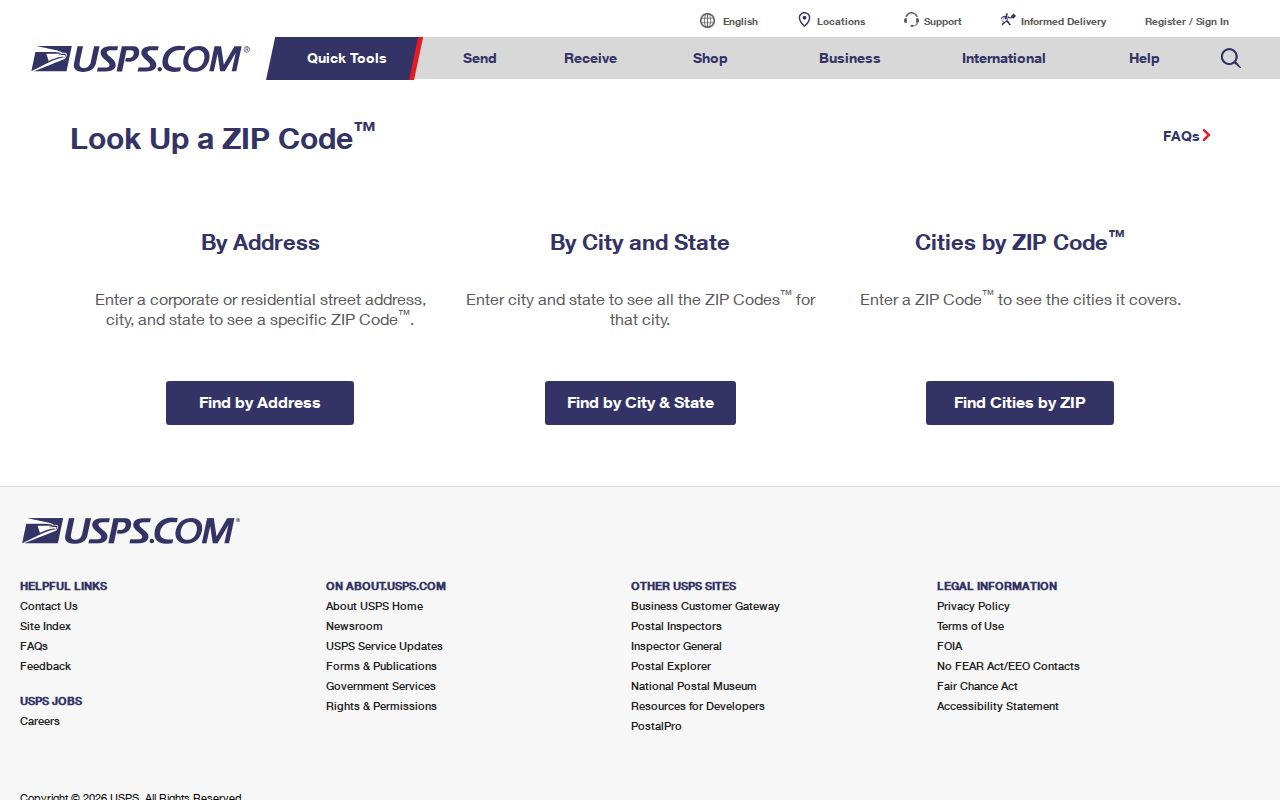
Pick the mode that matches the information in hand; a result answers a postal-delivery question, not who resides at the location.
| USPS mode | Field label | Type | Required | Options or format notes |
|---|---|---|---|---|
| Address to ZIP | Street address | Text | Yes | Enter the delivery address |
| Address to ZIP | City | Text | Yes | Use the recognized city name if known |
| Address to ZIP | State | Select/text | Yes | Choose or enter the state |
| Address to ZIP | Company | Text | Optional | Use only when the address is a company delivery |
| Address to ZIP | Apt/Suite | Text | Optional | Add the unit when one is part of the address |
| Address to ZIP | ZIP | Text | Optional | Can be supplied when checking a full address |
| City/state to ZIPs | City | Text | Yes | Enter the city |
| City/state to ZIPs | State | Select/text | Yes | Returns all listed ZIPs associated with that city/state |
| ZIP to cities | ZIP | Text | Yes | Returns the recognized cities associated with that ZIP |
The separate USPS City State Product contains city, county, Post Office, and ZIP associations and is updated monthly. It is a paid raw data file, not a static public statewide list. For a one-off address, the online lookup is the practical route; use the product when a current full association file is needed.
Find Louisiana Residents by ZIP Code
A ZIP filter narrows some public searches, but the available record depends on the local portal and the information it publishes. The Louisiana Voter Portal accepts ZIP on both Search by Voter and Search by Address. Some parish assessor forms also accept one, though a result may filter the mailing address or the situs address differently. GIS viewers usually work from a parcel or address instead of ZIP. Use this order to move from postal routing to a person or property record:
- Verify the complete street address and postal city with USPS; save the returned ZIP and spelling.
- Search the Voter Portal by name and ZIP or by the address form, then respect its protected-field limits.
- Use the Louisiana Assessors' Association directory to find the parish assessor and check whether its local form accepts ZIP or needs an owner, address, or parcel number.
- Open the local GIS only when parcel or address details are needed; use its parcel ID to reach the assessor record.
- Once the target is narrowed to a street, continue with the Louisiana street directory and its address-specific records.
The statewide tools are reachable from the Louisiana Secretary of State portal, but their results remain a limited voter record, not a complete list of everyone at a ZIP. A purchased voter-file request follows separate formats and use restrictions.
Louisiana ZIP Code, City, and Parish Lines
One Louisiana address can sit in different postal, municipal, parish, parcel, and court geographies. The USPS city name is a delivery label; it does not establish the city boundary or the parish with jurisdiction over a deed or court case. A ZIP may include unincorporated pockets, cross a parish line, or use a nearby town's name, while one municipality may use several ZIPs. Louisiana has 64 parishes, and no single parish assessor or clerk supplies a statewide property or court record.
The Louisiana DOTD parish map index helps identify parish boundaries; local GIS, planning, or E911 staff handle many municipal and rural address questions. Check the assessor and clerk for the parish where the parcel or case belongs, even if USPS returns a familiar city name from elsewhere.
Myth: Louisiana ZIP Code Results Identify Residents
A postal match confirms how USPS recognizes a delivery address. It does not prove that a person, company, or business is present there. The distinction matters because a voter result is a registration record, an assessor result names a parcel owner, and a permit or code entry names an applicant or responsible party. Those records answer separate questions even when they contain the same street line.
New Orleans illustrates the difference. One Stop's public code-enforcement hearing list can be searched by ZIP, but its basic permit search starts with a street address without ZIP; the city system may use a legally recognized address that differs from a resident's mailing form. A listed contractor, owner, applicant, or license holder is not automatically a resident. Read the result's type and date, then confirm the jurisdiction with the office that holds it. The official New Orleans One Stop help page describes its search behavior.
After a Louisiana ZIP Code, Search Parcels
Property systems answer an address question at parcel level. Louisiana has separate parish assessors, so begin with the parish suggested by the verified address, then see whether its assessor accepts owner name, street/situs address, or parcel/assessment number. A parcel ID is often the strongest exact key. Subdivision, lot, block, and legal description can help when an address changed or a rural route was renumbered.
Keep situs and mailing fields distinct: situs is where the land sits; mailing is where tax bills or owner correspondence go. A difference may reflect a nonresident owner, trust, estate, company, or mailing choice, but does not establish a person's home. Homestead exemption is a tax-related owner-occupancy indicator, not a roster of all residents. The statewide assessor directory can route a reader to the correct parish office; local phone, counter, and data-request channels can answer questions the public form cannot.
Louisiana ZIPs, Rural Routes, and PO Boxes
A statewide five-digit directory must account for more than ordinary street delivery. USPS maintains PO-box-only ZIPs, unique institutional assignments, and recognized city names alongside general routes. The ZIP Code list also changes as USPS maintains its delivery data. Treat postal terms as clues about the type of service, not as evidence about an occupant.
- ZIP and ZIP+4
- The five-digit ZIP routes mail to a broad delivery area. ZIP+4 adds four digits to narrow the delivery segment within it.
- PO-box-only ZIP
- A ZIP used for post-office box delivery rather than ordinary street addresses in the same way as a general area ZIP.
- Unique ZIP
- A separate ZIP assigned for a single institution or other unique delivery destination.
- Carrier route
- A USPS delivery route within a ZIP; it helps organize delivery but is not a resident list.
If an address search fails, try the recognized USPS city name, check the apt/suite field, and ask the local post office or address authority to clarify the delivery format. For questions about a postal assignment, use USPS; for the street's legal or municipal address, ask the local GIS, planning, or E911 office.
Historic Louisiana Address Changes
Modern ZIP routing cannot directly settle an old directory or property question. New Orleans City Archives says street cross-reference in directories begins in 1932. Before then, a reader needs an alphabetic directory entry, deed, plat, or historic map to bridge an old street name or number. Other Louisiana parishes have their own address authorities and uneven historical collections, so there is no statewide renumbering year or one universal crosswalk.
When an old place does not line up with a current ZIP, search by the legal description, lot and block, subdivision, historic map sheet, or assessor parcel history. A street rename, annexation, new subdivision, or rural-route conversion can explain a gap. Libraries and archives can supply the historic directory, map, or microfilm; the clerk and assessor remain the custodians for current land and filing records.
Why Louisiana's Complete ZIP List Changes
No stable, official, public statewide five-digit list with every ZIP, associated post office, and area was located. A printed directory can miss box-only service, a unique institution, or a changed city association. The USPS City State Product is comprehensive, updated monthly, and paid; its current file is the correct route when a complete association list is required. For everyday use, search each Louisiana city or post office with USPS and verify the full address.
The state's city/town directory offers a historical city, ZIP, and parish reference, but it is not a live postal master file. A Louisiana ZIP code directory can show verified regional families and explain where to route a search; it should not pretend that these groupings are a current list of every five-digit delivery code. Keep the USPS result date with any exported data, then route parcel, voter, court, or permit questions to the proper local custodian.