
Louisiana Resident Lookup Coverage
Each source answers a different question, and no single statewide file names everyone who lives in Louisiana. An assessor record identifies a parcel owner, a voter search reports limited registration information, and a court index points to a case filed in a particular court. Current certificates have eligibility rules; older indexes and directories have date and place limits. Treat the first match as a lead to check with its custodian, not as a complete profile or proof of a current home.
| Record | What It Confirms | Where | Access |
|---|---|---|---|
| Assessor and tax roll | Parcel owner, situs, mailing address, value, exemptions | Parish assessor and local GIS | Public owner data varies by parish; household members may not appear |
| Voter registration | Limited identity, ZIP/address search, election area, status | Secretary of State Voter Portal or Registrar of Voters | Public fields are limited; protected records require the registrar |
| Court docket | Party, case number/type, filing, events, disposition | Parish Clerk, eClerks, Clerk Connect, Supreme Court, or PACER | Local coverage differs; sealed and protected matters stay closed |
| Vital records | Birth, death, marriage, and family facts | LDH, State Archives, or parish clerk | Current birth/death certificates are closed; older indexes have set cutoffs |
| Succession or probate | Estate case, will, executor, heirs, judgment of possession | Parish Clerk and archival holdings | Ask the clerk for the case file and any access or copy limits |
| Business and license filing | Entity, officer/agent, credential, status, affiliation | Secretary of State and professional boards | Official affiliation information; a business address is not a home address |
| Custody or offender registry | Specific custody, supervision, or registry information | Louisiana DOC/LA VINE or State Police | Different legal purposes; not a general residence directory |
| Directory, yearbook, obituary | Dated address, school, occupation, death, or family context | State Library, State Archives, City Archives, local library | Historical and incomplete; cite the page and date |
When an address is the main fact, a Louisiana resident lookup should hand off to a parcel or street search. The Louisiana street directory follows the address-keyed assessor and deed trail; here, the goal is to verify one person across records that have different custodians and limits.
Louisiana Voter Lookup Fields
The Louisiana voter search asks for a name, ZIP, and birth month/year as separate fields; none of those text fields is marked required. The address form is a separate search, not a public link that reveals every registered voter's address history. Its own disclaimer withholds Social Security numbers, email, full birth date, mother's maiden name, assistance entitlement, and fully protected records. A result is only the public election information the portal allows, so it cannot settle every identity question. The Secretary of State's Search by Voter form is pictured with its name and date controls; a ZIP or birth month/year can help narrow similar names.
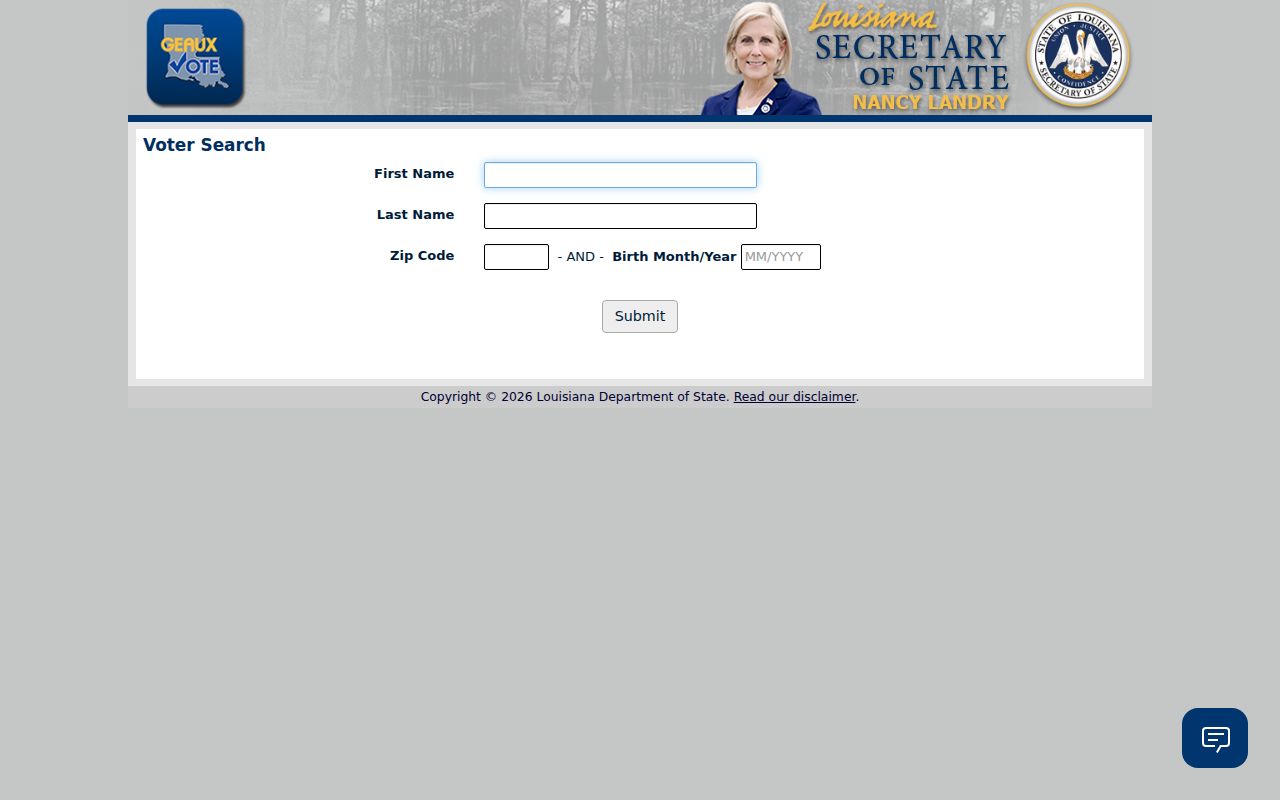
The name form helps distinguish a registration entry, but the public site does not expose the private fields listed in its disclaimer. For a resident lookup that begins with a known address, compare the portal's limited voter result with the parish record that actually holds the parcel.
| Search mode | Field label | Type | Required | Options or format |
|---|---|---|---|---|
| Voter | First Name | Text | Not marked | Known first name; spelling variants may help |
| Voter | Last Name | Text | Not marked | Surname paired with other fields |
| Voter | ZIP Code | Text | Not marked | Five-digit ZIP |
| Voter | Birth Month/Year | Text | Not marked | Enter as mm/yyyy |
| Voter | Search/submit | Button/control | To run | Runs the search and opens voter/election information |
| Address | ZIP Code | Text | Not marked | Postal ZIP for the address search |
| Address | Address | Text | Not marked | Street address |
| Address | Apt/Lot | Text | No | Apartment, lot, or unit |
| Address | City | Select | No | Louisiana city selector |
| Address | Search/submit | Button/control | To run | Returns information about voters at an address, subject to privacy rules |
The address search form shows ZIP, address, apartment/lot, and city controls.
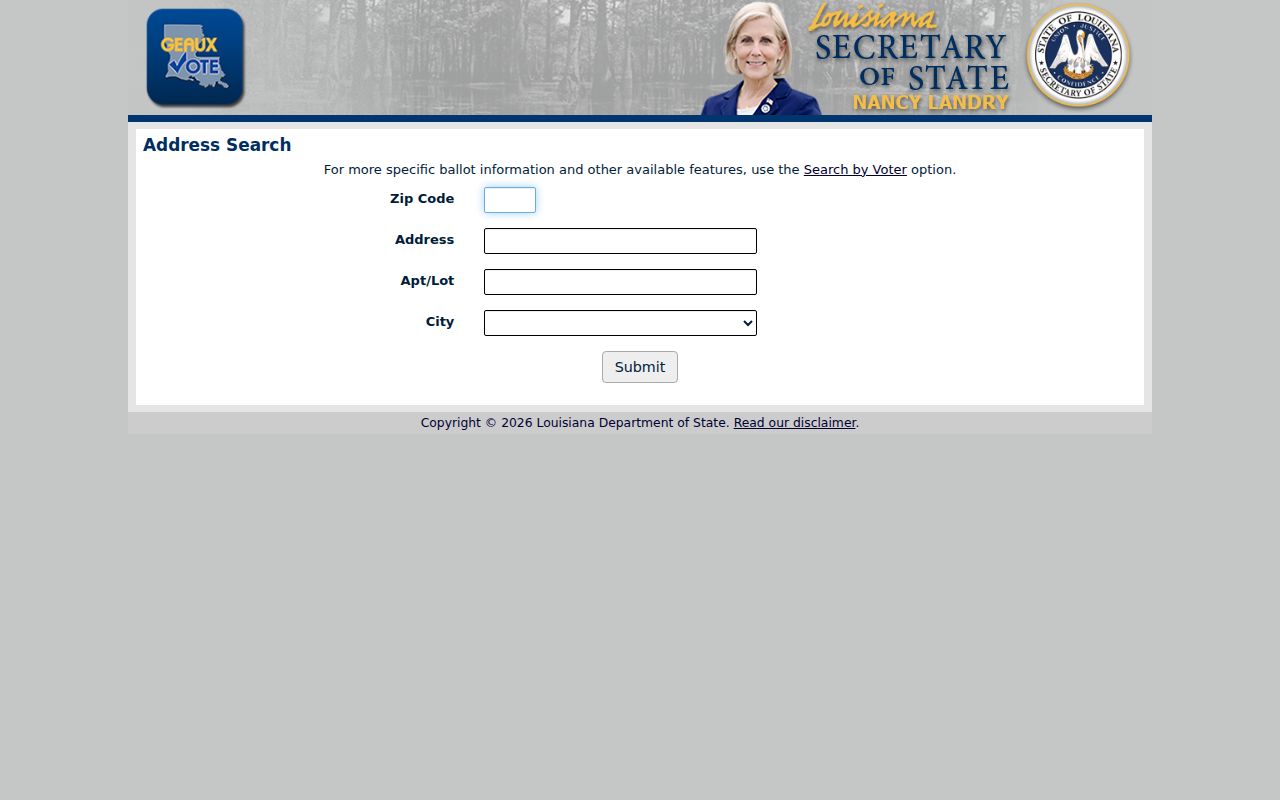
Enter the postal address as the registrar's form expects it, then use the displayed result only for the public information it supplies. Address mode is separate: the portal explains that voter and address records are not publicly linked beyond that search, which helps protect registrants. The Secretary of State's voter-list service offers electronic, PDF, label, standard-district, and special-district request options. List products may include home and mailing addresses, age, race, party, and standard districts; email is protected, and vote history is separate. Ask Elections Services at 225-922-0900 or the local registrar about the current format, price, and use limits. Historical poll books may require a registrar, clerk, State Archives, or parish library inquiry.
Louisiana Court Record Checks
Louisiana has several court levels and no single free statewide trial-court docket with every file. Choose the parish and court type first, then use that clerk's portal, Clerk Connect, eClerks, or courthouse terminal. The Louisiana Supreme Court public homepage provides Court Action releases, opinions, and docket links; its e-filing system is for authorized users, not public case access. The screenshot shows the public route, distinct from e-filing. Federal cases use PACER and its separate federal districts, while a municipal citation may remain with the city court rather than a district clerk.
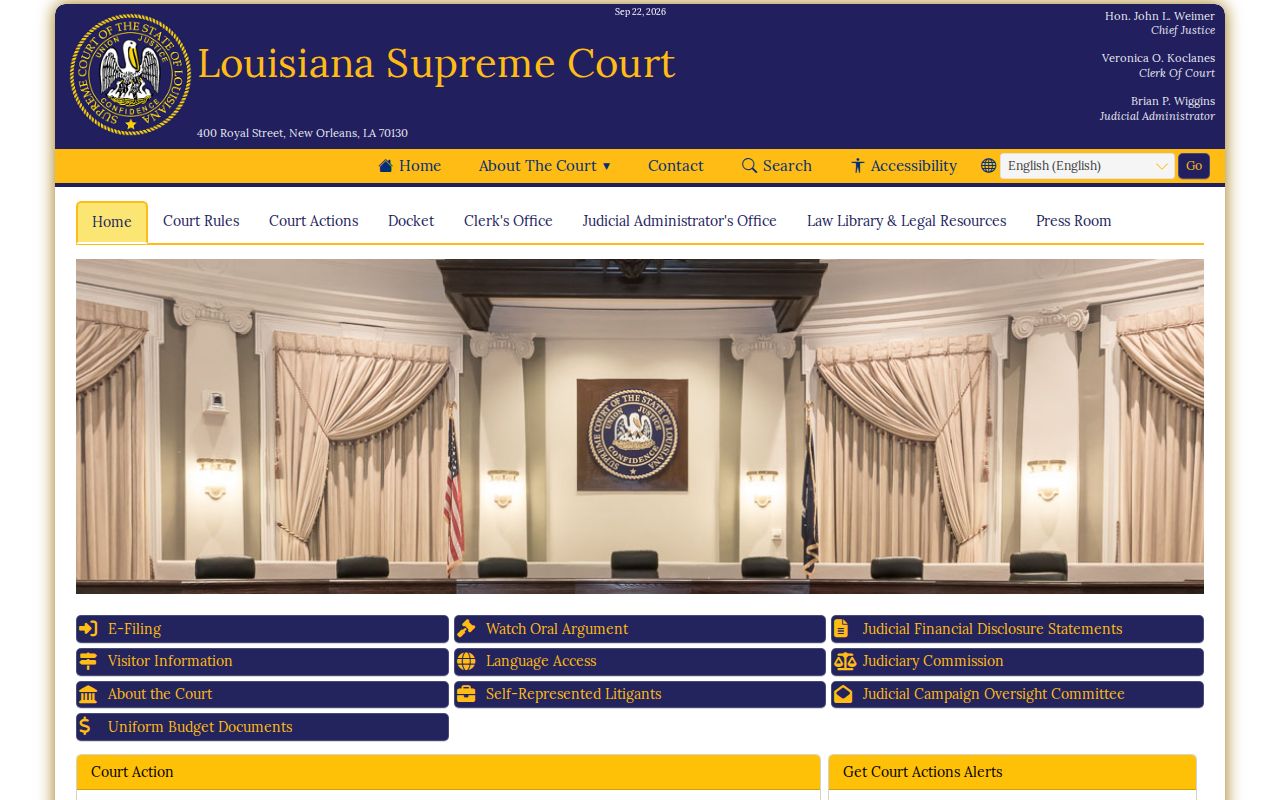
Open the public docket or opinion path that fits the question, and use the trial clerk for parish case files.
A Lafayette Clerk search documents one local example: civil suits from 1986, images from 2006, and criminal, traffic, family nonsupport, offense date, charge filed, case history, service, minutes, and disposition information. That local coverage is not a statewide promise. Other parishes can show a shorter index, charge for images, or keep older files at the counter. When reading an available court result, capture the supported identifying fields before deciding it is a match:
- Indexed party name and role, case number, filing date, court, and division.
- Case type, offense or petition description, and offense date when the local result shows it.
- Docket events or case history, service information, minutes, and disposition or judgment where displayed.
- Whether the document link is public, subscription-based, office-only, sealed, or redacted.
A name in an arrest or case index is not a conviction or a finding of liability. A resident lookup that relies on a court hit must check the parish, date, party role, case number, and final disposition with the clerk. Juvenile, sealed, expunged, adoption, and protected family material may not be open. A clerk can explain terminal access, archived files, copy charges, and certification, and can issue the official copy when a precise record is identified.
Myth: Louisiana Court Records Are All Online
An online case index is a partial view of a court's records, not a promise that every file, date, or document is on the web. Louisiana courts span parish and city systems, and older paper files may remain at a counter or in an archive. In 2025, Orleans announced a grant-supported case-management upgrade for its Criminal District Clerk and Court. The modernization notice describes an active change in digital access, not statewide historical coverage.
The same year, New Orleans criminal court records were mistakenly discarded and city workers searched a landfill. The episode shows why an index result, the clerk's paper file, and an official certified copy are not interchangeable. If the online trail is thin, ask the clerk whether a paper or archived record exists and how to inspect it.
Louisiana Vital Records Requests
Current Louisiana birth and death certificates are closed records. LDH keeps birth certificates confidential for 100 years after the birth year and death certificates for 50 years after the death year. Eligible requesters include the person named, current spouse, parents, adult children, siblings, grandparents, adult grandchildren, an attorney for an entitled person, and certain authorized applicants. A death certificate may also go to a named insurance or trust beneficiary. Some requests for another person's record need immediate-family authorization and the IDs LDH specifies; for certain child records, a custody judgment is required.
The LDH ordering page explains the closed-record notice, proof of identity, walk-in, mail, and VitalChek routes. Its application instructions are shown here.
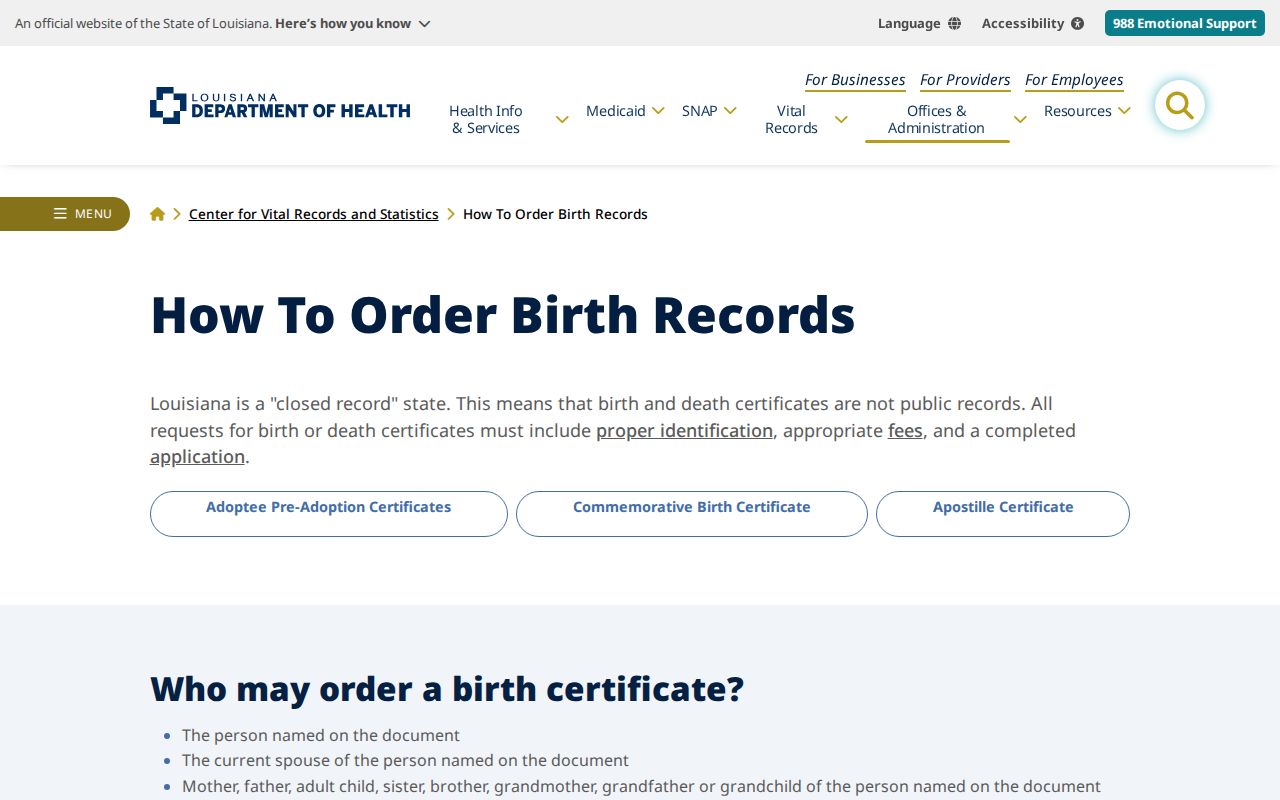
Use the current LDH instructions to confirm the applicant category and documents before sending payment or a form. LDH lists fees of $15 for a birth certificate, $24 for a birth certificate plus birth card, $7 for a death certificate, and $10 for an evidentiary document. A mail or VitalChek order also carries a $0.50 state charge; VitalChek adds its own security and shipping costs. Walk-in payment accepts cash, check, or money order at the Central Office, 1450 Poydras Street, Suite 400, New Orleans, from 8:00 a.m. to 3:30 p.m. except state holidays. Mail orders use the LDH application, a check or money order, and supporting ID sent to P.O. Box 60630, New Orleans, LA 70160. Online, phone, and kiosk orders go through VitalChek. LDH retains a no-record search fee and describes a full search as the cited year plus two years on either side.
The inspected packet does not set a fixed current processing time, so check the LDH page or call before planning around a delivery date. Marriage licenses are requested from the parish clerk that issued the license; divorce records are court files, sometimes paired with a vital-statistics certificate.
Louisiana Historical Birth Records
Once a record passes its privacy cutoff, the State Archives provides a different route from LDH's current certificate service. Public indexing covers births more than 100 years old, deaths more than 50 years old, and Orleans Parish marriage licenses more than 50 years old. The Archives' inspected index includes Orleans births from 1819 through 1921 with a limited 1790–1818 index, Orleans marriages from 1870 through 1971 with an 1831–1869 index, Orleans deaths from 1819 through 1971 with an 1804–1818 index, and statewide deaths from 1911 through 1971. These are index coverage limits, not proof that every parish event survives. The historical birth index offers basic and advanced search controls, shown below.
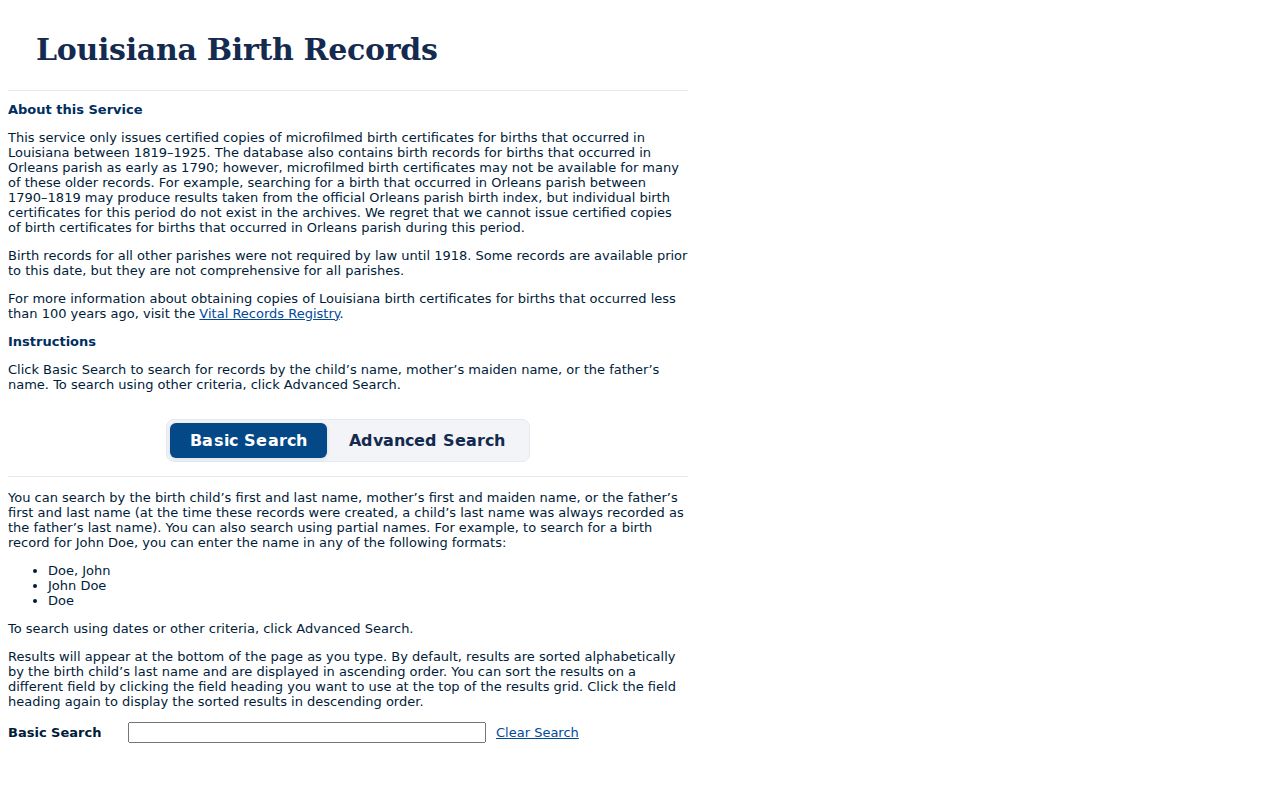
A surname search needs a name, place, and date or a three-year span; compare the returned index entry with family and parish details before requesting a copy. For a resident lookup involving an older event, remember that statewide registration was not required until 1918, so non-Orleans births before then may be missing unless a parish kept its own record. For mail copies, the Archives lists $5 for a photocopy and $10 for a certified copy; an on-site self-service noncertified copy is listed at $0.50. The Archives application explains its request form and search details. Older marriage records outside Orleans go to the parish clerk that issued the license, and older parish or church registers may need archival or library research.
Verify One Louisiana Resident
A careful Louisiana resident lookup is a sequence of checks, not a single name hit. Start with a spelling and place, then add a second custodian that records a different event. This matters in a state where French, Spanish, Creole, Acadian, German, Italian, Vietnamese, and other naming traditions appear in records. Accents, apostrophes, compound surnames, initials, maiden names, remarriages, and phonetic spellings can shift an entry in an index. Keep the source's spelling, date, parish, and address together as you compare it.
- Write down the full name and known parish, approximate year, ZIP, or address; note alternate spellings and former names.
- Use the voter name or address search for the public fields available, then compare a parish assessor entry only as parcel-owner evidence.
- Search the relevant court by parish and case type; use the case number, filing date, party role, and disposition to separate same-name results.
- Check an eligible vital index or historical collection to distinguish generations, then ask the custodian what official copy can be released.
- Record the date checked and source. If a current detail matters, call the registrar, clerk, or office that maintains it.
- Docket
- A court's ordered record of filings and events in one case. A docket entry is not necessarily the full file or the final decision.
- Index and image
- An index is a searchable pointer to a record; an image is a scan of the filed document. Images can be paywalled or available only at the office.
- Certified copy
- A copy issued and authenticated by the record's legal custodian for an official use that requires certification.
Owners, voters, licensees, and people named in a case are not interchangeable evidence of who lives at a property. Compare unrelated records, respect a missing or protected result, and do not fill gaps with assumptions about a household.
Louisiana Heirs and Adoption Records
For an heir or family estate, search the parish clerk's succession or probate index instead of treating a tax roll as a family list. A file may name a decedent, executor or administrator, will, heirs, and judgment of possession. An obituary can point to relatives or an executor, and a recorded deed may show when heirs later received or transferred property. Use a case number to request the actual file; names and addresses in estate documents can be sealed or redacted.
The trail is parish-specific. Clerks may offer a web index, terminal access, paper docket books, or a request route. The State Archives' microfilm guide lists historical probate and court material for selected parishes. Call the clerk to confirm whether a file is on site, archived elsewhere, or eligible for a certified copy. Pair an heir's name with the estate date and relationship, and use obituaries, local libraries, or family-history collections as dated leads rather than proof of current residence.
For an adoption reunion: adoption records are confidential and sealed. LDH's Adoption Reunion Registry can be reached at 800-259-2456. An adopted adult who is at least 24 may request a pre-adoption certificate through the state process; a birth parent may file a Contact Preference Form for contact, intermediary-only contact, or no contact. Follow the identity and signature rules, honor the stated preference, and ask LDH which current form applies. The registry is an official family-reconnection path, not a public name index or a way around sealed records.
Louisiana Resident Business Affiliations
The Secretary of State's Commercial Search tests a person's reported business connection, not where that person resides. The form has three mutually exclusive modes: entity name; charter, trade-registration, or name-reservation number; and officer or agent name. The selected mode's field is required. Officer/agent searches use first and last name. Entity-name searches can use the first few letters, ignore punctuation and entity endings, and may need a phonetic variant such as Cajun/Kajun. A charter number is nine characters with a letter; trade, trademark, or service numbers use two digits, a hyphen, then four digits.
The Secretary of State Commercial Search form displays the three person and entity search modes captured below.
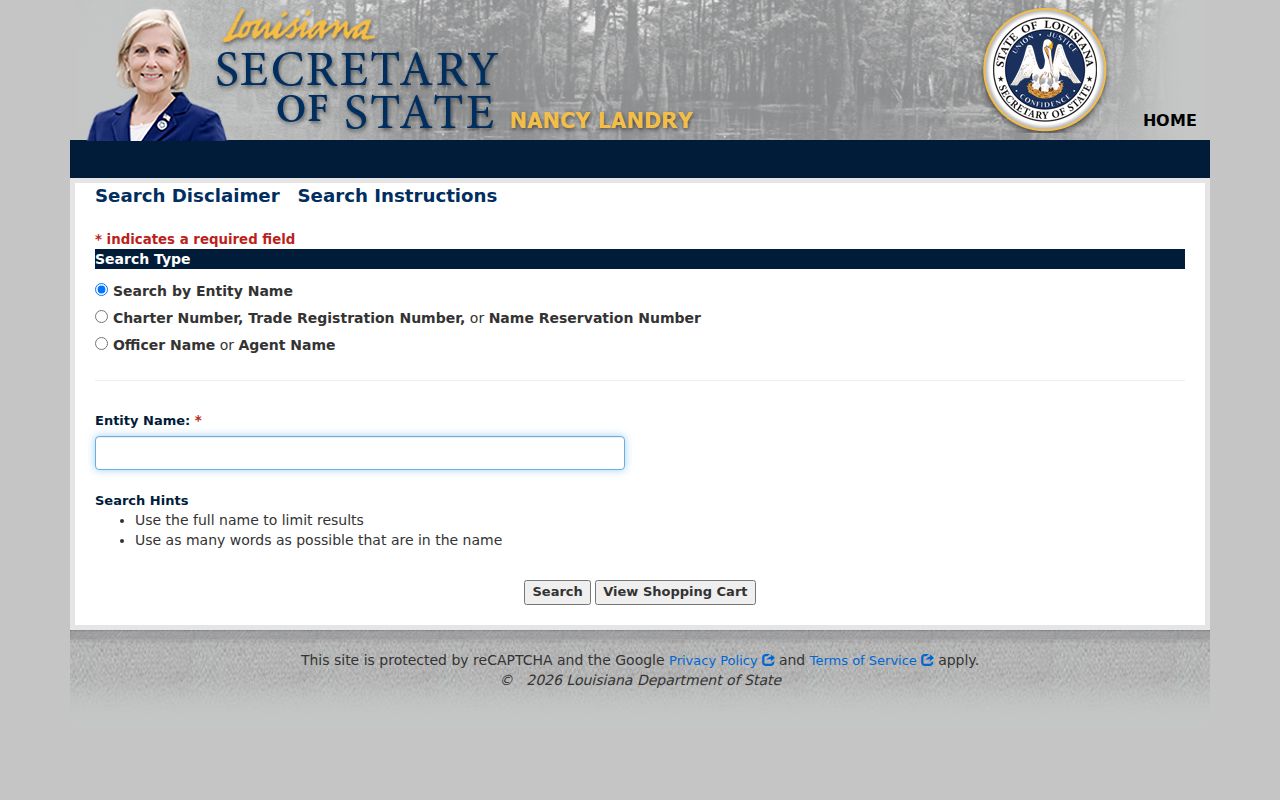
Start with the mode that matches the known name or number; the search result shows a reported business affiliation, not a home address.
Possible result details include entity name and type, charter or trade number, status, registered agent, officers or members, filing dates, principal or mailing address, and linked documents. Check the current result for exact fields. A registered agent, officer, licensee, or principal can be tied to a business without living at its listed address. The Louisiana State Board of Medical Examiners offers free online practitioner verification; its written verification is listed at $25. Board pages and local license records can confirm a credential or affiliation, but each has its own scope and update process.
Louisiana Status Records Have Narrow Uses
Custody and offender systems answer specific safety or custody questions. The Louisiana Department of Public Safety and Corrections locator searches state custody and some supervision information by name, location, or ID/case, updates daily, and gives a phone fallback at 225-383-4580. It does not find every person held in a parish jail, and Louisiana has no single statewide parish-jail roster. For a local booking question, use the relevant parish sheriff or jail source, or LA VINE where it covers the event. The Louisiana DOC locator page describes its name, location, and ID search route.
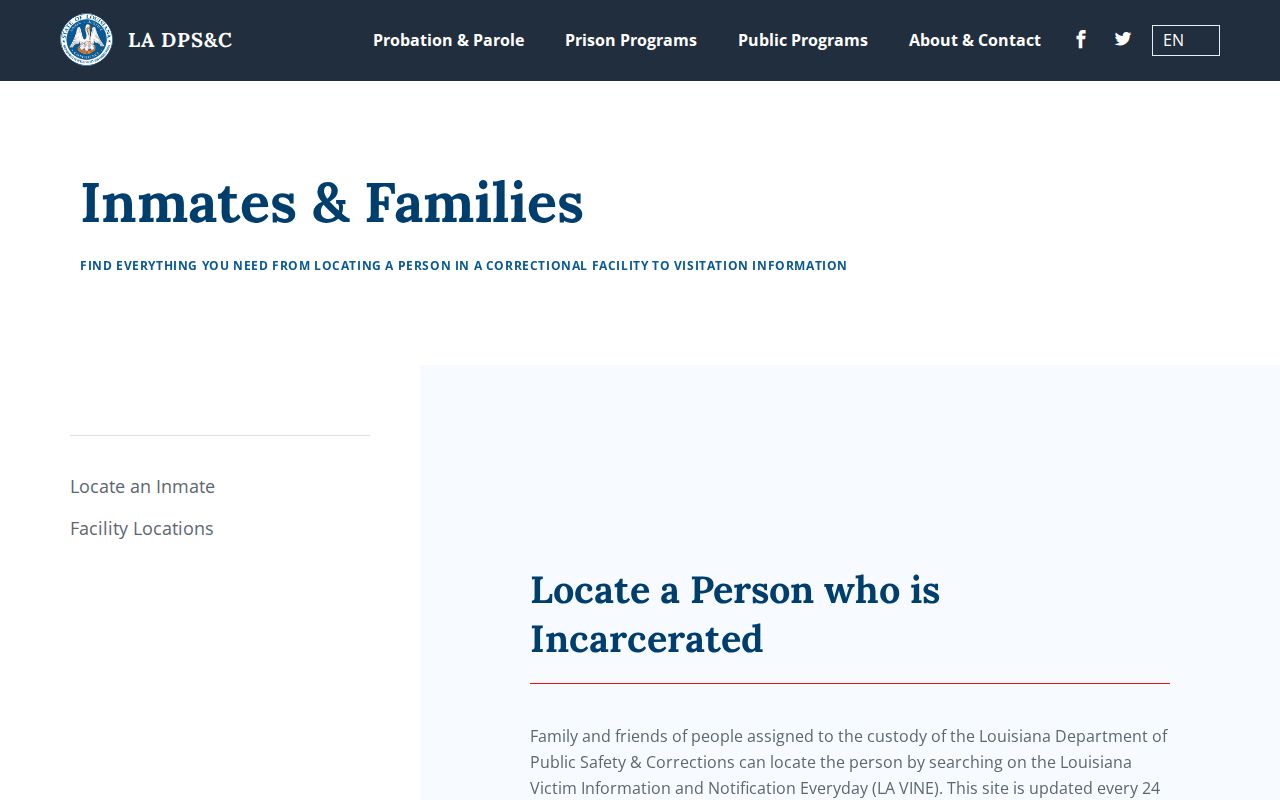
Use the locator for custody or supervision status, then contact the listed agency if the entry needs clarification.
The Louisiana State Police registry is a separate legal record with its own conditions of use and reported location information. Its entry may include a photo and conviction information, but a registry address is not proof of ordinary residence for every other purpose. The State Police registry page states the rules readers must accept before using the official registry.
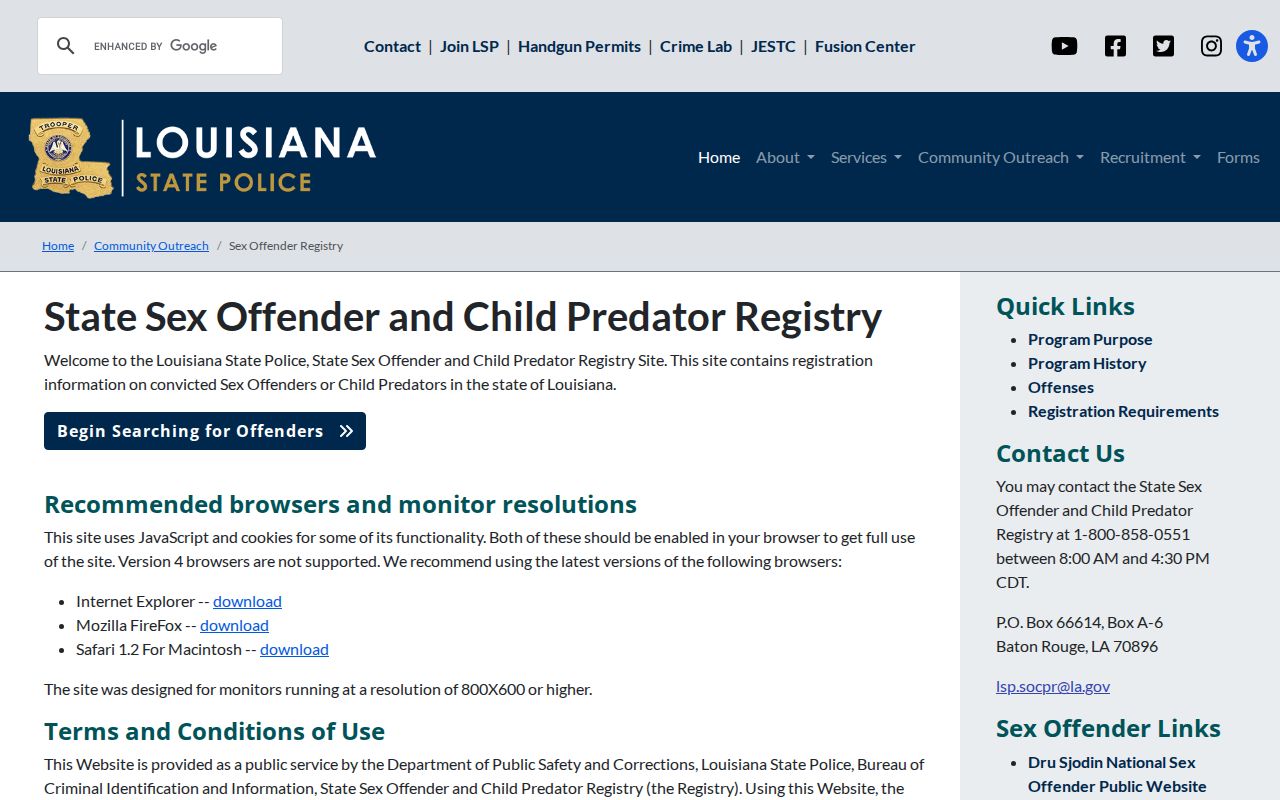
Read and follow those conditions, and keep a registry record distinct from voter, court, and custody information.
Louisiana Archives and Record Requests
When a state or parish search stops online, move to the custodian rather than treating an empty result as proof that no record exists. The Louisiana Public Records Law, La. R.S. 44:1, 44:31, 44:32, and 44:35, allows an adult to inspect or copy nonexempt records. There is no fee for inspection; reasonable copy or electronic-transmission charges may apply, with advance payment possible. If a public-record question is raised, the custodian generally must respond within five business days with a legal basis or a time estimate. An immediately available electronic record requested in writing has a three-business-day production rule.
Make a narrow request that names the record, person or parcel, parish, and date range, and ask for nonexempt portions if protected information can be redacted. The State Archives Research Library offers records, microfilm, assessment, church, immigration, military, and land material; it can be reached at 225-922-1208. The Archives Research Library page explains in-person access. Parish and local libraries, the State Library, and the New Orleans City Archives also offer distinct historical paths.
Louisiana Privacy for Resident Searches
Myth: everything is public once it appears in a government record. Louisiana withholds protected voter information, current vital certificates, adoption material, juvenile and sealed records, Social Security numbers, personal emails, and certain public-employee or protected-official details. Driver address information is controlled by federal privacy law, and private utility customer lists are not public rolls. A request for a public record does not override a separate confidentiality rule; ask the custodian to release any nonexempt portion instead.
The Louisiana Address Confidentiality Program serves eligible adults, guardians, and household members moving because of actual or threatened abuse, sexual assault, or stalking. An application assistant submits the request, then the Secretary of State issues a program card and substitute address for state and local services. The program forwards mail, but it cannot protect a home purchased in the participant's name. An actual residence and telephone are not made public through the program. Public-employee home addresses and personal contact details are also confidential in personnel records. Additional nonpublication protections apply to judges, magistrates, district attorneys, and related officials; follow the current statutory procedure before expecting information to be removed.
Louisiana law also prohibits using public information to target someone. Stalking, cyberstalking, threatening electronic messages, and repeated harassing contact can be crimes. Public access does not grant permission to threaten, trespass, expose protected details, or repeatedly contact a person.
Lawful use. Use public records for lawful personal research, family history, record correction, or civic inquiry. Never use a result to stalk, harass, intimidate, threaten, or harm another person.