
Searching the Louisiana Residents Directory
There is no master resident roll for Louisiana. Start with the record that matches the question. A known street points to a parish assessor and local map; a person’s name may fit the voter portal or a clerk index. For family history, the State Library and State Archives hold material that current online searches do not. Louisiana has 64 parishes, so the same person may appear in a city system, a parish record, and a state index under different spellings or place names.
Use one result to find the next source, then compare details that come from different custodians. A tax roll names an owner and a mailing address, not every person at the site. Voter search is limited by privacy rules. A deed shows parties to a recorded transfer. None alone proves who lives at an address today. These are the first steps in a careful Louisiana residents directory search.
- Write down the parish, city, or ZIP tied to the name or address.
- Use the parish assessor directory to open the correct owner and parcel search.
- Check the Louisiana Voter Portal or a parish Clerk of Court index for a separate record.
- For an older household, compare a directory, census entry, obituary, or archive index.
- Ask the custodian by phone, at the counter, or through a written request when the record is not online.
Louisiana Records Offices
Statewide portals cover voter, vital, archive, and business records, but property and court files still follow the parish where an event or filing took place. The Parish Clerk of Court also acts as recorder for conveyances and mortgages. The Louisiana Assessors’ Association lists all 64 parish offices. Each custodian sets its own index coverage, fees, and copy process, so use the state links to locate the right local office before ordering.
Louisiana State Archives
3851 Essen Lane
Baton Rouge, LA 70809
Library: 225-922-1208
Louisiana Vital Records
1450 Poydras Street, Suite 400
New Orleans, LA 70112
Walk-in: 8 a.m.–3:30 p.m.
Louisiana Elections Division
8585 Archives Avenue
Baton Rouge, LA 70809
Elections Services: 225-922-0900
Find a Louisiana Resident by Name
The Louisiana Voter Portal separates searches by voter and address. Name search asks for first name, last name, ZIP code, and birth month and year. Those fields narrow a match but do not return every voter or a household list. The portal keeps voter and address records unlinked; ask the parish registrar about an unclear result rather than infer a move.
| Portal Field | Type | Required? | Use and limit |
|---|---|---|---|
| First Name | Text | Not marked | Try a known spelling or initial. |
| Last Name | Text | Not marked | Check a maiden or other recorded surname when relevant. |
| ZIP Code | Text | Not marked | Use a five-digit postal code as a narrowing field. |
| Birth Month/Year | Text | Not marked | Enter mm/yyyy when known; full birth date is not public. |
| Search | Button | Needed to run | Check the portal disclaimer and ask the registrar about protected records. |
A separately ordered voter-list product can include home and mailing address, age, race, party, and district fields. Email and fully protected records remain restricted, and list use has conditions. A no-result screen is not proof that a person left Louisiana or that an address is vacant.
The separate address form accepts ZIP, street, apartment or lot, and city. Read its result only for the election information it returns; it is not a census of everyone at the location.
Route Louisiana Resident Searches by Parish
Parish lines govern many deeds, court cases, assessor rolls, and marriage files. City and postal names can differ from those lines, and a family may have records in several parishes after a move. Start with the address or event location, then check the state boundary layer if the custodian is uncertain.
The LADOTD parish boundary layer identifies parish geography, while the state’s parish map index points to local map resources. These tools locate a jurisdiction; they do not show who lives on a parcel. For a current address search, move from the boundary to that parish’s assessor or clerk.
When a family moved, preserve the place name printed on an old record and note the modern parish separately. A postal city can cross parish lines or an older community name may have changed; keeping both forms prevents a valid record from being discarded as a mismatch.
Louisiana Residents Directory: Current Sources
Current records answer different questions: assessors name owners, the voter search returns limited registration information, and clerks index parties to recorded acts or cases. None is a list of everyone who lives at a location.
| Record source | Who may appear | Custodian | How to reach it |
|---|---|---|---|
| Assessor parcel and tax roll | Owner of record, mailing and site address, parcel facts | Parish assessor | Use the 64-office directory, then call or visit locally. |
| Voter Portal | Some registration and election details | Secretary of State and parish registrar | Free name or address search; protected fields are withheld. |
| Conveyance index | Grantor and grantee in recorded acts | Parish Clerk of Court | eClerks, Clerk Connect, local portal, terminal, or copy request. |
| Court docket | Named parties to a case | Parish or municipal clerk | Local search, counter, phone, or written request; case access varies. |
| Historical directory or archive index | Past household or business entries | Library or archive | Online index, reading room, microfilm, appointment, or search request. |
Use an owner record to identify a parcel, then check a second custodian. Mailing addresses can belong to an estate or nonresident owner; voter results are not household counts, and court indexes are not case files. Add a parish, year, or case number to distinguish people with the same name.
Louisiana has no single statewide trial-court index. A district or city file usually begins with its local clerk. Use the court, parish, case number, and filing date to identify a same-name case before ordering papers or a judgment.
Official records and commercial profiles answer different questions.
| Source type | What to expect |
|---|---|
| Official parish or state record | Named custodian, jurisdiction, record type, dates, and a route to ask about an image or copy. |
| Commercial people-finder profile | May combine public filings and submitted data, merge people with similar names, or show an old address; verify any claim at the source office. |
New Orleans Permit Records for Louisiana Residents
New Orleans One Stop searches public permits, licenses, planning projects, and code cases from 2007 to the present. Basic search needs no account; a free advanced account adds description keywords, Council District, record type, and date ranges. Results can export as CSV and may name an applicant, but a city filing does not prove residence.
Start with the street address alone, without city, state, ZIP, or apartment details. If it fails, check for a different recognized address or a pending subdivision update. The One Stop search instructions show the fields and address tips:
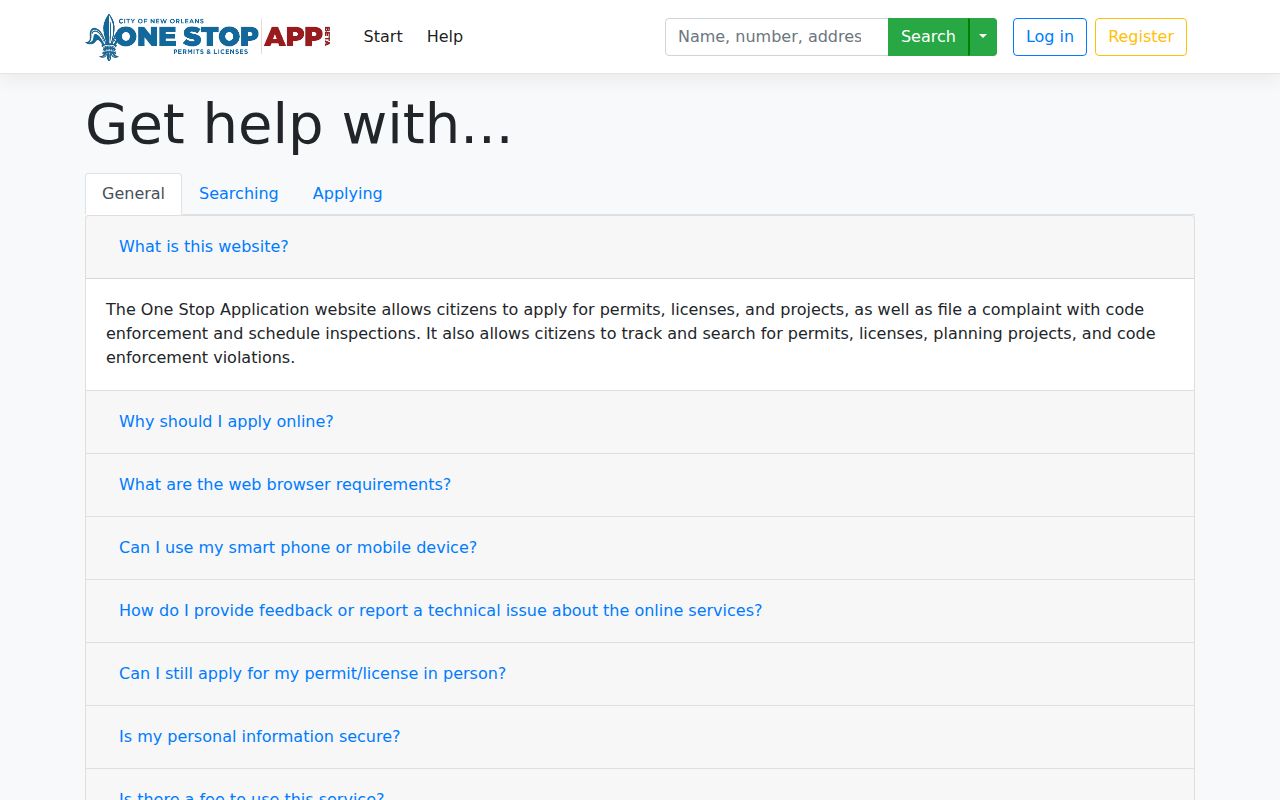
The screenshot shows advanced filters and the download option. Use the current system for an individual record, and ask the relevant New Orleans office when a document or address does not resolve.
A no-match can reflect an address variant, pending subdivision update, or data error. Search results are described as real-time, though map exports may lag. For help, call 504-658-7100 with the address and record type.
Louisiana Assessor Records
Louisiana has no single statewide parcel search. The Louisiana Assessors’ Association lists 64 parish offices, each with its own portal and field labels. Many search by owner or address, but result fields and online years vary. Keep the physical situs address separate from the tax mailing address, and treat a homestead exemption or owner name as a parcel clue rather than a household list.
For a local search, begin at the association directory or call the assessor. Staff can say whether a spelling, parcel number, subdivision, lot, or legal description will find the right card; copy fees and delivery depend on the parish.
New Orleans offers a concrete example: the Orleans Parish Assessor portal searches by owner surname, tax-bill number, property address, exempt property, business personal property, or map. A parcel card can show assessed value and exemptions, but maps and building sketches are not legal surveys, and the office warns that tax data can be incomplete or outdated.
Louisiana Clerk Records by Name
The Parish Clerk of Court keeps conveyance and mortgage records and many local court files. The statewide eClerks LA page routes to parish land, marriage, civil, and criminal systems. Clerk Connect serves participating parishes. A parish may show only an index, require a subscription for images, or keep older books on site. The clerk remains the official custodian even when a vendor hosts the search.
The eClerks LA statewide entry page shows how to choose a parish and move into land, marriage, civil, and criminal record categories:
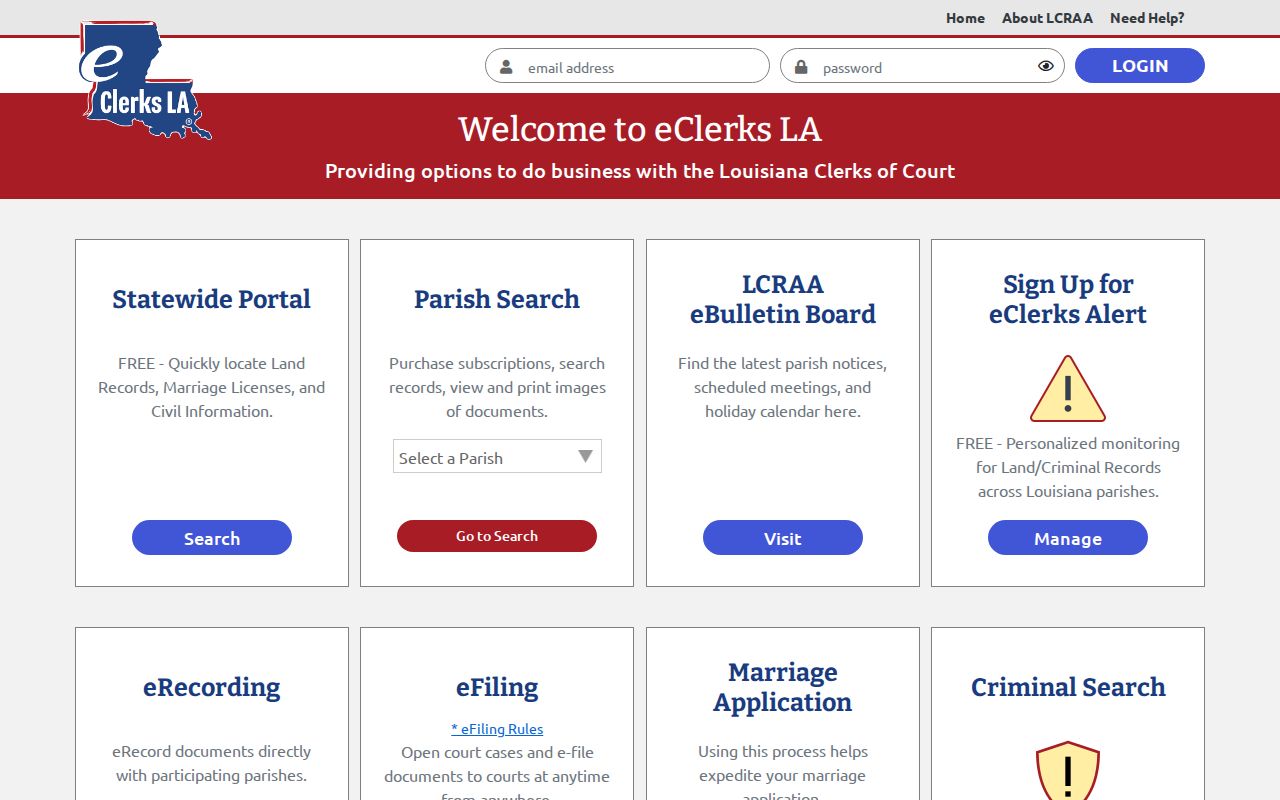
Choose the parish before searching. The portal links help locate an index, while the parish clerk can explain image access, book references, and certified copies.
The Clerk Connect records landing page gives a second example of a participating-parish search layer:
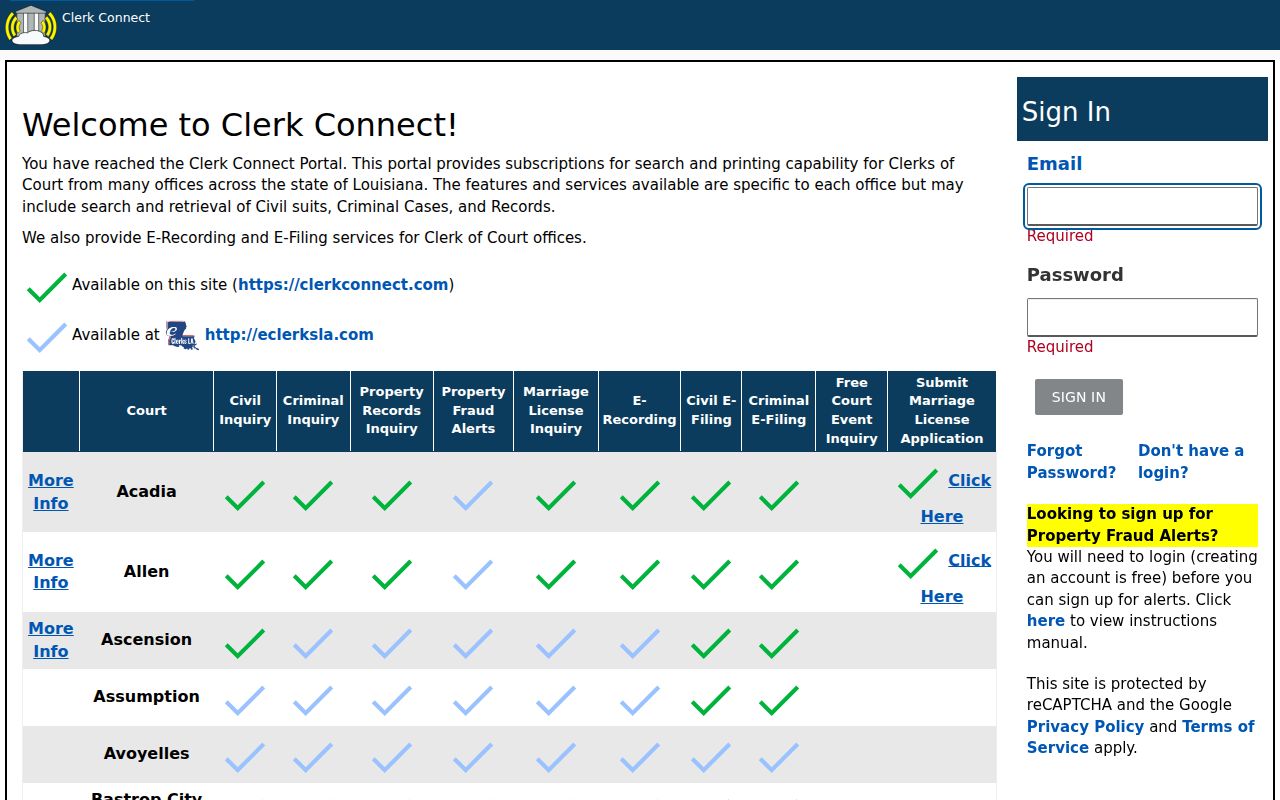
When an online index stops at a cutoff, ask the clerk for a public terminal or older deed and court books. The Archives microfilm guide can point to parish series, but permission may be needed because the clerk retains the records. Lafayette shows why a cutoff must be checked by party role: its vendor and vendee indexes begin in different years. Search both sides of a conveyance, then note the instrument number or book and page before asking for an image or certified copy.
- Roll
- A list kept for one purpose, such as property tax or voter registration.
- Index
- A pointer to a record, not always the record image itself.
- Parcel
- A mapped piece of land identified by a local number or legal description.
- Criss-cross directory
- A book or database arranged by street address so a researcher can work from a place to a printed name.
Historical Louisiana City Directories
New Orleans has city directories reaching back before statehood, with some holdings from 1811 onward. The historic street cross-reference begins in 1932, and no city directory was issued for 1862–1865. Earlier address searches need a name, deed, tax record, church source, newspaper, or map to bridge gaps. The State Library’s Louisiana Collection and New Orleans City Archives preserve these records in different formats.
A directory places a printed name at a place and time; it does not confirm a current occupant. The Louisiana city directory collections guide describes year runs, formats, and access routes. Compare any entry with census, church, newspaper, or deed evidence before drawing a conclusion about a household.
Louisiana Vital Records for Resident Searches
Current birth certificates are confidential for 100 years after the year of birth; death certificates are closed for 50 years. A current certified copy requires an eligible requester, an application, identification, and a fee. A person’s death alone does not open a recent certificate to everyone. Louisiana did not require statewide birth registration until 1918, so early records outside Orleans Parish can be sparse.
For a current order, the Louisiana Department of Health lists walk-in, mail, and VitalChek routes. Its fee schedule lists $15 for a birth certificate, $7 for a death certificate, and a $0.50 state charge for mail orders; check eligibility and current prices before sending payment. The State Archives index and parish clerks provide separate routes for older public entries and marriage records.
Louisiana Archives for Resident Records
The Louisiana State Archives Research Library holds about 30,000 cubic feet of records, including census indexes, passenger, church and military materials, assessments, and parish microfilm. Its Baton Rouge library is open weekdays from 8 a.m. to 4 p.m., but access to archival material ends at 3 p.m. Staff recommend appointments for permanent collections; bring the collection name, parish, and likely date range.
The State Library’s Louisiana Collection is open without an appointment and includes directories, phone books, newspapers, maps, microfilm, family histories, and licensed databases. Its reference desk is at 225-342-4914. The State Archives grew from a 1954–56 records survey and was established in 1956. Parish microfilm holdings differ, and some use requires permission from the clerk who retains the records.
Louisiana Business Name Records
The Secretary of State’s Commercial Search connects a person with an entity, not necessarily with a home. Search by entity name, charter or trade-registration number, or officer and agent name. Entity searches may accept first letters and ignore punctuation or company endings, so test a supported spelling variant when needed.
A result can identify an organization, filing role, or business address, but that address is not residential evidence. Full filings may require a separate account or payment step. Local license and permit systems differ by city and parish; confirm a filing’s meaning with its issuing office.
Louisiana Records Aren't All Online
Louisiana has no single statewide parish-jail roster; the arresting sheriff is the local route. The Department of Public Safety and Corrections locator covers state custody and some supervision data and updates every 24 hours. A phone inquiry requires a name plus date of birth or DPS&C number.
Custody and registry records have separate access conditions and limited coverage. A result is not proof of ordinary residence. Ask the clerk or sheriff about juvenile, sealed, expunged, or other restricted files, and use the case number, filing date, and disposition to distinguish same-name court records.
Louisiana Privacy Rules for Resident Records
Louisiana law withholds some personal details from public search. The voter site excludes Social Security numbers, email, full birth dates, a mother’s maiden name, and fully protected records. The Address Confidentiality Program gives eligible people escaping abuse, sexual assault, or stalking a substitute address for state and local services. Its protected location is not a public address lead.
State law also limits publication of some public-employee and protected-official details. The 2026 changes to R.S. 44:11.2 revise removal and nonpublication procedures, so use the current statute rather than promise that a website or record will always be removed.
Use records lawfully. Public access does not allow threats, repeated unwanted contact, stalking, or harassment. Respect protected records and ask the custodian about a lawful, personal, family-history, estate, or civic request.
The Secretary of State’s Address Confidentiality Program explains eligibility and application through a certified assistant. If you need a public file, ask for non-exempt portions when protected fields can be redacted.
Louisiana Public Records Requests for Residents
When an index is missing, send a focused request to the office that owns the record. Louisiana Public Records Law, La. R.S. Title 44, gives an adult the right to inspect or copy public-body records unless an exemption applies. R.S. 44:1 includes paper and electronic material used in public business, subject to confidentiality rules. Name the agency, record type, parish, person or parcel, date range, and requested copy format.
R.S. 44:32 makes inspection free and permits reasonable copy or electronic-transmission fees. A custodian generally has five business days to respond; a written request for an immediately available electronic record has a three-business-day production rule. Ask the office for its fee schedule and whether an uncertified scan, public terminal, or mailed copy is available.
If a search finds no file, check the State Library, local library, or parish microfilm guide and ask whether the clerk retains older books. For paper copies, provide a return address and note whether certification is needed; retrieval, postage, and certification may have separate charges.
Recent Louisiana Resident Record Changes
A July 2025 LSU Libraries grant supports new digitization tools and partnerships for the Louisiana Digital Library. It may expand access, but does not mean a particular parish item is already online; check the catalog and date range.
Orleans Parish reported a grant-backed case-management upgrade in 2025. Paper files and older records still matter, and an index, a clerk’s file, and a certified copy are different records. Ask the clerk which one answers the question.
For deed alerts, use the Parish Clerk’s current alert option. St. Tammany’s recording-alert page also points to eClerks alerts across parishes.